Move a Tree the Right Way:
Transplant Services Near the Point Fire Memorial
The Point Fire Memorial sits on Swan Falls Road, about 7 miles south of Kuna — deep in Canyon County's high-desert canyon country. If you live near Swan Falls Road or anywhere along the Kuna corridor, the drive north to our tree farm in Nampa takes roughly 20–25 minutes via ID-45. That's close enough to haul a tree, meet with our crew, or schedule a transplant visit.
Canyon County soil is alkaline and clay-heavy. It's common across Nampa and Kuna alike, and it changes how every transplant has to be handled. Trees that thrive in wetter climates often struggle here without the right soil prep and species selection.
The Swan Falls and Kuna corridor sees about 11 inches of rain yearly. Winds push past 30 mph during storm events. Soil is compacted silty loam on most lots. These conditions aren't a deal-breaker — but they do mean a transplant done without local knowledge carries real risk.
If you're searching for a tree transplant near me from the Point Fire Memorial area, Canyon County's most experienced transplant crews are based right here in Nampa.
We're familiar with the ground you're working with.
Canyon County Soil Makes Tree Transplanting Different Here
Nampa and Kuna sit at roughly 2,500 feet elevation in a semi-arid high-desert zone. That elevation and dry climate shape everything about how trees grow — and how they survive being moved. Nampa falls in
USDA Plant Hardiness Zone 7a, which means specific temperature ranges and frost timing that affect every transplant decision we make here.
Annual rainfall here averages about 11 inches. Your trees depend on irrigation, not rain, to stay healthy year-round. That pressure doesn't stop after a transplant — it increases.
Soil in older Nampa and Kuna neighborhoods often tests above pH 7.5. That's alkaline enough to lock out nutrients that trees need to recover after a move. Clay hardpan can sit as little as 18 inches below the surface in parts of Nampa — the depth varies by lot. That layer stops roots from reaching deeper moisture and slows drainage after watering.
Trees that do well in Portland or Boise's North End often struggle here without soil prep. Species like honeylocust and hackberry tolerate Canyon County's conditions without amendments. Maples usually need sulfur added before they can settle into high-pH soil. On newer lots off Franklin Road and Iowa Avenue, compacted builder's fill is common — it acts like a wall against root expansion.
Knowing what's below the surface before transplant day is the difference between a tree that establishes and one that declines quietly over two seasons.
When a Tree on Your Property Needs to Move, Not Come Down
A mature shade tree can reduce your summer cooling costs in a real, measurable way. Before you call for removal, it's worth asking whether the tree just needs a better location on your property.
There are clear signs a tree should move rather than come down. It may be healthy but too close to a foundation. It might be blocking solar access for panels or a garden. It could be in direct conflict with a new build or addition. In each of those cases, transplanting is a practical option — not just a sentimental one.
Moving a large specimen is often faster and less expensive than growing a replacement from scratch. Most trees at Melad Tree Farm range from 5 to 10 years old. That's years of growth you'd be starting over without if a healthy tree comes down unnecessarily. Take a look at our projects to see the range of transplant and planting work we've completed across Canyon County and the Treasure Valley.
If your property is near Lake Lowell, pay attention to your lot's elevation. Low-lying lots in that area carry a higher water table, which raises root rot risk after a transplant if drainage isn't planned ahead of time.
Nampa's City Ordinance governs trees in public rights-of-way.
Trees on private property carry fewer restrictions, but it's still worth confirming any HOA or ACC rules in your specific subdivision before scheduling a move. Kuna homeowners near the Swan Falls corridor often have open lots with room to reposition trees without much friction.
How to Prepare Your Yard Before
Transplant Day
Before any digging starts on your property, call Digline at
1-800-342-1585. Nampa residents are required to do this before breaking ground. It's a free call, and it marks underground utilities so your crew knows what's below.
Check for overhead power lines along the path the tree needs to travel and at its new location. Nampa's City Ordinance restricts certain species near utility line clearance zones. If lines run close to your target planting spot, flag that before transplant day — not during.
Know what kind of soil you're working with. Silty loam drains quickly and dries out fast. Clay holds water longer and can suffocate new roots if drainage isn't considered when digging the receiving hole. Both types are common across Nampa and Kuna lots, and each requires a different approach to hole prep.
Clear a path wide enough for the equipment. Larger spade trucks need at least 10 feet of clearance from the pickup point to the drop location. Walk that path ahead of time and remove anything that blocks it.
Take photos of your tree before the crew arrives — trunk caliper, branching structure, and the root zone from multiple angles. This helps your transplant team size the right equipment and set accurate expectations.
Plan your post-transplant watering schedule in advance.
First-year trees need deep, slow-soak watering once a week. Two to three inches of compost and wood-chip mulch around the base helps hold moisture in sandy loam soils common on Kuna-area properties.
Getting Here from Kuna and the
Swan Falls Road Corridor
From the Point Fire Memorial, exit the parking lot toward S Swan Falls Road. Turn left onto S Swan Falls Road and follow it north for about 2 miles.
Turn left onto Kuna Cave Road and continue for 4 miles. Turn right onto Dickman Road/S Robinson Road and follow that for 2.6 miles. Turn left onto Bowmont Road/Southside Boulevard — continue to follow Bowmont Road.
Turn right onto ID-45 North and stay on it for 3.5 miles. Turn left onto Emerald Road/Lake Shore Drive — continue to follow Lake Shore Drive for 4.4 miles. Melad Tree Farm will be on the left at 12747 Lake Shore Drive, Nampa, ID 83686.
The full drive runs about 20.6 miles and takes approximately 25 minutes under normal conditions. Our property accommodates trucks and trailers, so if you're hauling a tree or bringing a larger vehicle, you'll have room to maneuver on arrival. We serve customers across Canyon County and the Treasure Valley — see our full service area locations for more details.
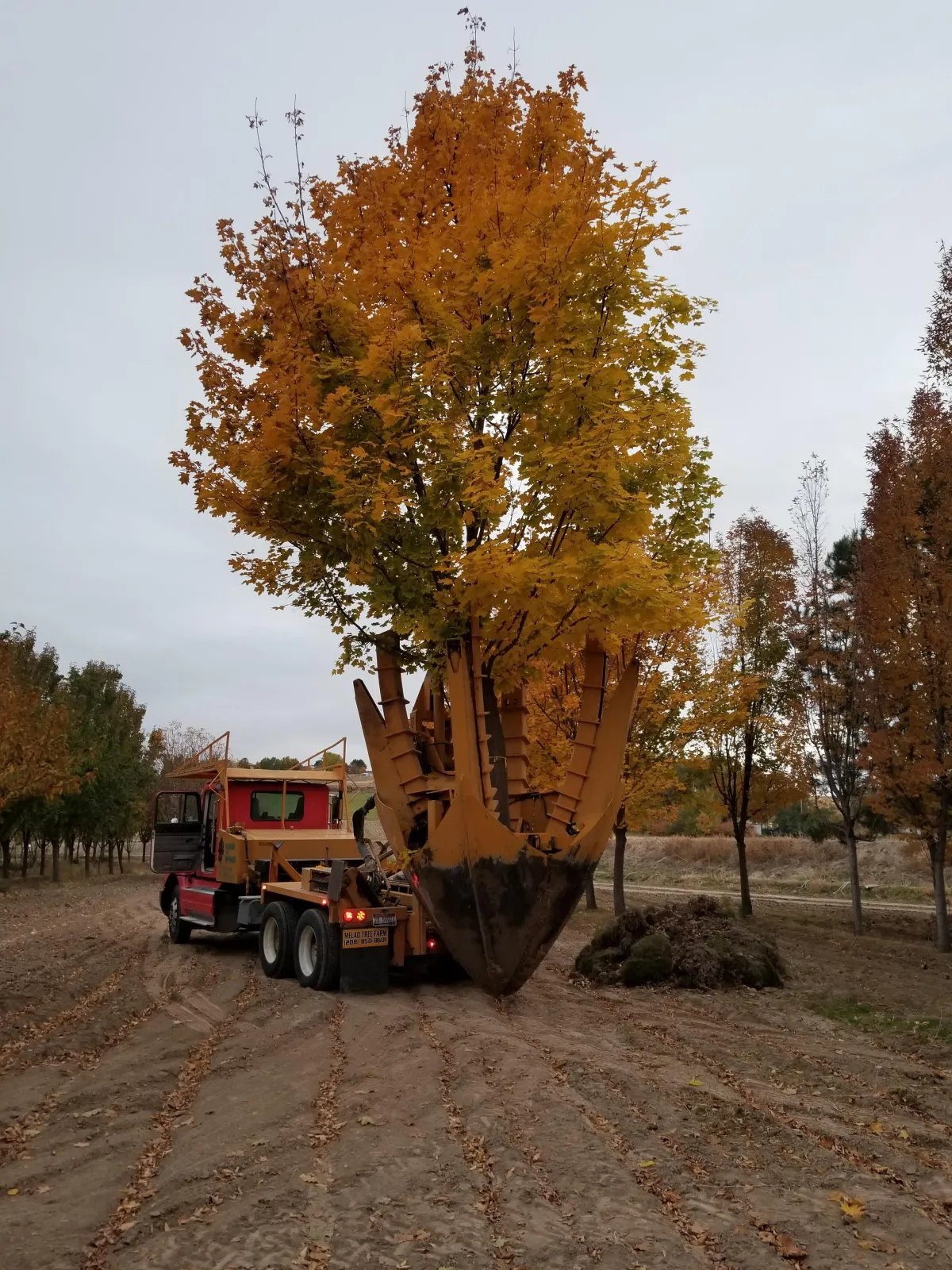
What Happens During a Professional Tree Transplant in Nampa
If you've never had a spade truck on your property, here's what to expect. The crew uses hydraulic blades to cut cleanly around and beneath the root ball. The tree lifts out in one piece — roots, soil, and all. You can learn more about our full approach on our Nampa tree transplant service page.
Trunk caliper determines which spade size the job requires. Larger specimens need bigger equipment. When you contact us, having a rough measurement of your tree's trunk width helps us match the right machine to your tree before we arrive.
The receiving hole gets dug first. When possible, the tree moves in a single trip from its old location to its new one. Minimizing time out of the ground reduces stress on the root system, which matters more in Canyon County's dry air than it would in a wetter climate.
Some transplant shock is normal. You may see yellowing leaves, wilting, or early leaf drop in the weeks after the move. That's the tree redirecting energy to root recovery rather than foliage. It doesn't mean the transplant failed.
A root stimulator applied at planting time helps reduce shock symptoms in Canyon County's dry, alkaline soil. Staking is often needed on Nampa's open lots where strong afternoon winds are a regular occurrence — without support, a freshly moved tree can shift before roots anchor it.
Timing matters. Transplants done during dormant season — late fall or early spring — carry the highest survival rates in this area.
The fall planting window closes in late November when Canyon County ground begins to freeze.
After the Move: Keeping a Transplanted Tree Alive in High-Desert Heat
Water deeply once a week for the first full year after the move. Lawn sprinklers don't cut it — their spray doesn't reach the depth new roots need. Use a slow-soak method: a drip line, a soaker hose, or a hose left running at low pressure near the base for an extended period.
To check whether your tree actually needs water, dig down 6 to 7 inches near the root zone. If the soil ball falls apart on the third bounce, water now. If it holds together and feels damp, you can wait another day or two.
Afternoon winds in Nampa and Kuna pull moisture from leaves faster than most homeowners expect. On open lots — which are common across the Swan Falls corridor and newer Nampa subdivisions — that wind exposure is constant. A freshly transplanted tree loses water through its leaves even when the soil feels adequate.
Keep mulch 2 to 3 inches thick around the base. Leave a few inches of clearance between the mulch and the trunk itself to prevent rot at the bark line. Wood-chip mulch holds moisture well in the sandy loam soils common on Kuna-area properties.
On clay-heavy lots, avoid over-watering. Clay holds water significantly longer than sandy loam. Check soil moisture before each watering cycle rather than watering on a fixed schedule.
Pull weeds from around the base by hand. Competing plants draw water away from new roots during the most critical establishment period.
Watch for these signs of establishment failure by the following
spring: no new bud growth, bark cracking at the base, or wilting that doesn't recover after watering. If you're seeing any of those, contact us before the problem gets further along.
Frequently Asked Questions
Trees are serious, and so are your questions. Here are just a few:
Is the Point Fire Memorial in Nampa or Kuna?
The Point Fire Memorial is located on Swan Falls Road, approximately 7 miles south of Kuna — not within Nampa city limits. Nampa is roughly 25 minutes north via ID-45. Melad Tree Farm serves homeowners traveling from the Point Fire Memorial area, the Swan Falls corridor, and Kuna.
What trees survive Canyon County's alkaline soil without a lot of extra care?
Honeylocust and hackberry are strong choices for Canyon County's high-pH soil — both tolerate alkaline conditions without amendments. Maples can work here too, but they often need sulfur added to the soil before planting to perform well long-term.
Does transplanting work on trees that are already large?
Yes — spade truck equipment is built to handle large specimens. Trunk caliper is what determines which spade size the job requires. When you reach out, having a rough measurement of your tree's trunk width helps us match the right equipment before we arrive.
When is the best time of year to transplant a tree near Kuna or Nampa?
Dormant season gives transplanted trees the best chance of survival — either late fall or early spring. Transplanting during dormancy reduces stress on the root system. In Canyon County, the fall planting window closes in late November when the ground begins to freeze.
Do I need a permit to move a tree on my own property in Nampa?
Private property trees in Nampa carry fewer restrictions than trees in public rights-of-way. Trees in rights-of-way fall under Nampa's City Ordinance. Regardless of location, call Digline at 1-800-342-1585 before any digging — it's required and free.1
How far is it to drive from the Swan Falls Road area to the Nampa tree farm?
The drive from the Point Fire Memorial to Melad Tree Farm at 12747 Lake Shore Drive, Nampa runs approximately 20.6 miles and takes about 25 minutes. The route follows Swan Falls Road north to Kuna Cave Road, then connects to ID-45 North before turning onto Lake Shore Drive.
COMPANY
CUSTOMER CARE
LOCATIONS
NEWS
LEGAL


© Copyright 2026. Melad Tree Farm. All Rights Reserved.