Move a Tree the Right Way Near Storey Park in the Treasure Valley
Storey Park sits at Main Street and Franklin Road in Meridian — one of the busiest corners in the Treasure Valley. Nampa and Meridian yards are growing fast. When new construction crowds an established tree, moving it carefully is often the right call.
This page covers tree transplant service near Storey Park for homeowners across Nampa, Meridian, and Canyon County. Whether your yard is a new build or an older property, we can help you move a tree without losing it.
Canyon County soils are often alkaline and clay-heavy. That matters when you transplant a tree. The right soil prep and timing make the difference between a tree that survives and one that doesn't.
Idaho Power lines run through many Nampa and Meridian neighborhoods. Digline rules require a call before any digging. We account for both before we ever break ground on your property.
How to Know if Your Tree Can Be Transplanted in Nampa's Climate
Not every tree is a good candidate for transplanting. The size of the trunk is one of the first things we look at. Trees with a trunk caliper under 2–3 inches move best with a strong survival rate. Larger trees can be moved, but they need root pruning done months ahead of the actual move.
Nampa sits in USDA Hardiness Zone 7a. That gives us two reliable transplant windows each year:
Spring: March through April, before summer heat sets in
Fall: October, after temperatures drop and before the ground freezes
Avoid transplanting in July or August. Nampa's average July high reaches around 91°F. That kind of heat puts serious stress on a freshly moved tree.
If your yard is in a newer Garrity-area subdivision, you may already have smaller nursery trees that are well-sized for transplanting. These move cleanly and settle in quickly when the timing is right.
A few tree species that do well in Treasure Valley transplants:
Maples
Flowering pears
Thornless honeylocusts
These are all listed on the Treasure Valley Tree Selection Guide and proven performers in local soils and climate conditions.
What Happens During a Professional Tree Transplant Near Storey Park
If you've never moved a tree before, here's what to expect when our team comes to your yard. The process is straightforward, but each step matters for the tree's survival.
Site visit first. We check for overhead Idaho Power lines and underground utilities before anything else. Idaho law requires a Digline call before any digging — we handle that as part of our process.
Root ball sizing. We dig the root ball to the right diameter for your tree. The standard is roughly 10–12 inches of root ball for every inch of trunk caliper. Cutting corners here is the most common reason transplanted trees fail.
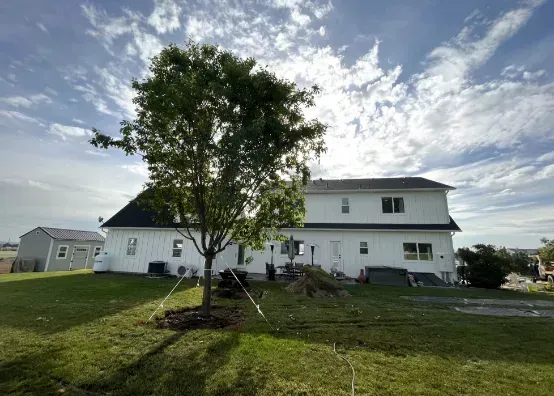
From there, we wrap the root ball, transport the tree safely, and set it at the correct grade in its new location. Planting depth matters — the tree goes in at the same depth it grew before, no deeper.
Before we leave, we set your watering schedule. A transplanted tree needs deep, consistent watering for one to two full growing seasons. We walk you through exactly what that looks like for your yard.
Nampa's Forestry Division maintains around 3,500 city trees in parks and along city streets. We follow the same best-practice standards they use — applied to private lots across the Treasure Valley. You can see the range of projects we've completed for municipalities and homeowners alike on our project page.
Soil and Site Prep That Keeps Transplanted Trees Alive in Canyon County
Canyon County soils are not always transplant-friendly straight out of the ground. High pH and low organic matter are common across Nampa, Meridian, and nearby Caldwell yards. We amend the soil at planting time to give your tree a better start.
Drainage is just as important as soil chemistry. We test drainage at the new site before we dig. A tree sitting in pooled water after a transplant will not recover — catching that problem early saves the tree.
If your yard is in a newer subdivision near Southern Ridge or Copper River Basin, expect compacted subsoil. Construction grading packs the earth down hard. We account for that during site prep so roots have room to spread.
A proper mulch ring is one of the simplest things you can do to protect a transplanted tree through Nampa's dry summers:
- Apply 3–4 inches of mulch around the base
- Keep mulch away from direct contact with the trunk
- Refresh it each season as it breaks down
Nampa's Forestry Division recommends soil samples through the Canyon County Extension office before planting in urban sites. For transplants in neighborhoods like Franklin Village or Brookdale Estates, that extra step can tell you a lot about what your tree is going into.
How to Reach Our Tree Farm and Schedule a Transplant Visit
Melad Tree Farm is located at 12747 Lake Shore Dr, Nampa, Idaho. We're in North Nampa and easy to reach from most Treasure Valley communities.
From Meridian (near Storey Park): Take Franklin Road west out of Meridian. Pass the Meridian Speedway and continue into Nampa. Turn toward Lake Shore Drive in North Nampa and follow it to 12747.
From Caldwell: Take Nampa-Caldwell Boulevard east toward downtown Nampa. Connect to Lake Shore Drive heading north and follow it to our address at 12747.
From downtown Nampa: Take I-84 to the Garrity Boulevard exit. Head north on Garrity, then follow Lake Shore Drive to our farm.
Walk-ins are welcome if you want to see the trees in person. That said, calling ahead to confirm species and caliper availability saves you a trip — our inventory moves seasonally and varies by tree type.
Spring and fall booking fills up fast. Those are our two peak transplant seasons, and we schedule quickly once the weather is right. Reach out early to hold your spot.
Rules and Permits Nampa Homeowners Need to Know Before Moving a Tree
Before you move a tree in Nampa, it's worth knowing what the city requires. The rules depend on where the tree sits — on your private lot or in the public right-of-way.
Right-of-way trees require a free permit. If your tree is in or within 15 feet of the right-of-way, you need to apply with the City of Nampa before anything is moved or removed. The permit is free, but skipping it can create problems with the city. Full permit details are available on the Nampa Parks & Recreation ROW Tree Program page.
A few other right-of-way rules to know:
Only City Forester–approved species may be planted in the ROW
Evergreens that grow over 3 feet at maturity are not allowed in the right-of-way
Only tree companies licensed by Nampa's Forestry Division may work on ROW trees
Digline is required before any digging in Idaho. Call 1-800-342-1585 before we break ground anywhere on your property. This is state law, not optional.
If your home is near Garrity Boulevard, additional rules apply. Garrity is a designated landscaping corridor under Nampa municipal code. A 15-foot buffer rule applies to commercial and redevelopment properties along that stretch.
HOA yards have an extra step. Many Nampa and Meridian HOAs require written board approval before a tree is moved or removed on a private lot. Check your CC&Rs before scheduling anything. We've seen homeowners skip this step and run into delays — a quick check upfront saves time.
We Serve Yards Near Storey Park, Garrity, and Across the Treasure Valley
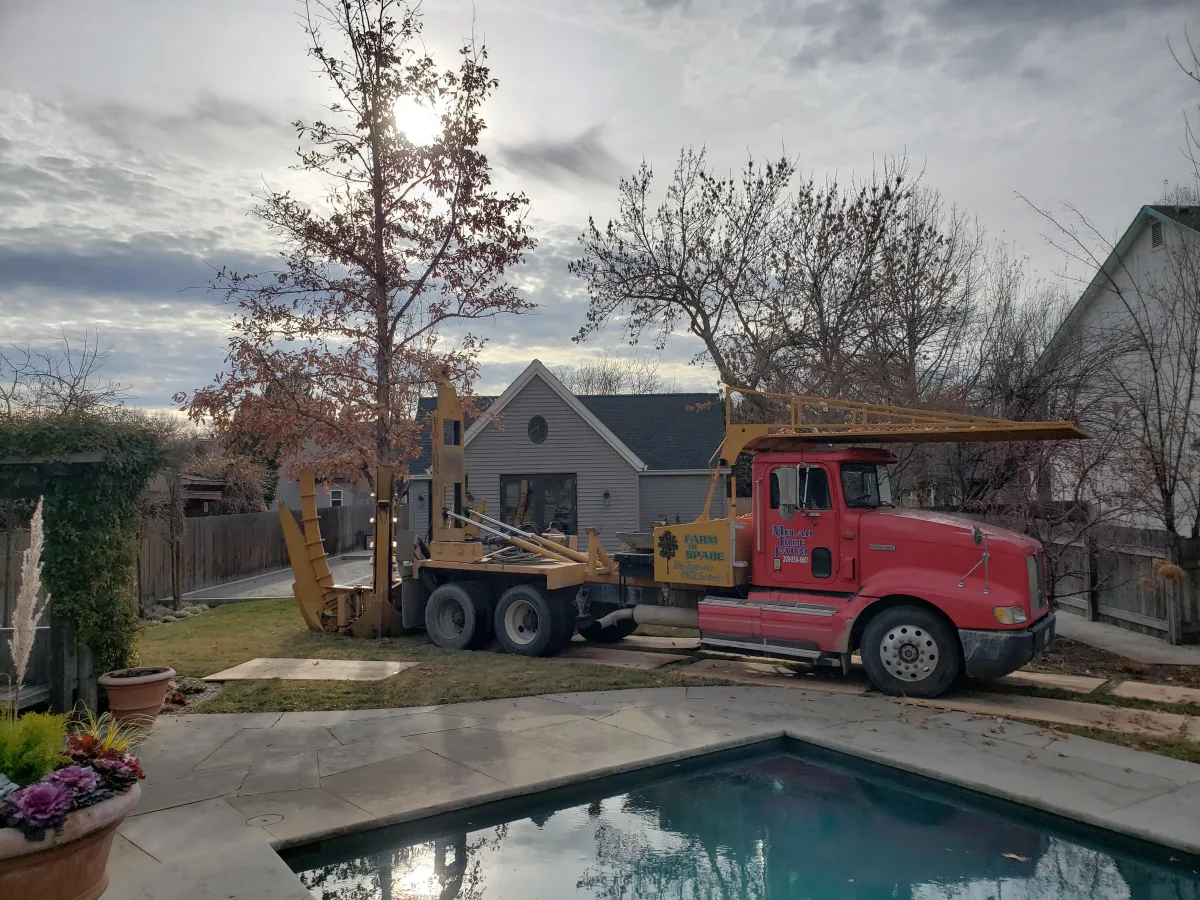
Our tree transplant service is mobile — we come to your yard with the right equipment. You don't need to haul anything or arrange transport. We handle the full move from your current site to the new location.
We regularly serve yards in:
Nampa — Garrity, Franklin Village, Brookdale Estates, Southern Ridge
Meridian — neighborhoods near Storey Park, Kleiner Park, and the Meridian Dairy Barn area
Caldwell and Star — similar soil profiles to Nampa, same transplant timing windows
Middleton — welcome too; reach out to confirm scheduling for your area
Garrity is one of our most active service areas. With around 11,388 residents and a gardening-active community, we see steady demand for transplants in both older established yards and newer builds.
For customers near Storey Park and Franklin Road in Meridian, one scheduling note: Storey Park hosts the Meridian Monday Night Market weekly through the summer. Traffic near Franklin Road picks up on those evenings. We recommend booking transplant visits on non-market days for easier access and a smoother job day.
Caldwell and Star yards share the same alkaline, clay-heavy soil profiles we see across Canyon County. The transplant approach — and the timing windows — are the same. See the full list of communities we serve on our locations page.
Frequently Asked Questions
Trees are serious, and so are your questions. Here are just a few:
When is the best time to transplant a tree near Nampa?
Spring (March–April) and fall (October) are your two best windows in Nampa's Zone 7a climate. July and August heat averages around 91°F — that's too stressful for a freshly moved tree. Plan your transplant outside of peak summer.
Do I need a permit to move a tree in my Nampa yard?
No permit is needed for trees on your private lot. A free permit is required if your tree is in or within 15 feet of the public right-of-way. Contact the City of Nampa before moving any tree near the street.
Can my HOA stop me from moving a tree in my yard?
Many Nampa and Meridian HOAs require written board approval before any tree is moved or removed on a private lot. Check your CC&Rs first — this is one of the most common delays homeowners run into before a transplant.
Does Storey Park area soil affect how I care for a transplanted tree?
Treasure Valley soils are often alkaline and clay-heavy across Nampa and Meridian. Amend your soil at planting time and apply a 3–4 inch mulch ring around the base. Those two steps make a real difference in how well your tree settles in.
How big of a tree can actually be transplanted successfully?
Trees with a trunk caliper under 2–3 inches move best. Larger trees can be transplanted, but they need root pruning done months before the actual move. We assess size and condition during the site visit.
Do you need to call Digline before digging in Nampa?
Yes — Idaho law requires a Digline call before any digging, anywhere in the state. The number is 1-800-342-1585. We make this call as part of our standard process before any work begins on your property.
COMPANY
CUSTOMER CARE
LOCATIONS
NEWS
LEGAL


© Copyright 2026. Melad Tree Farm. All Rights Reserved.